



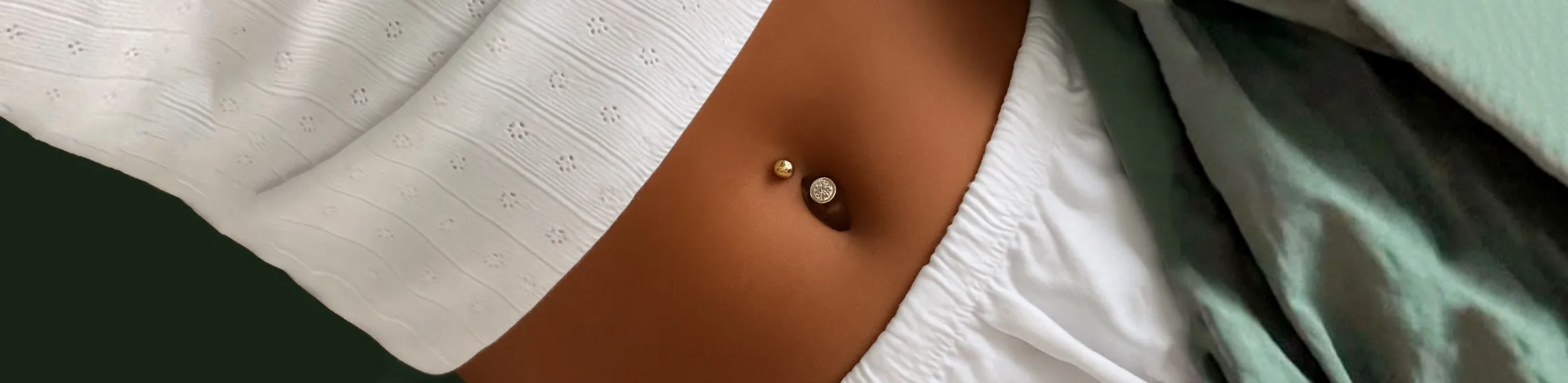
Navel piercing – a timeless accessory
A navel piercing has been a favorite piece of jewelry for a very long time. Its popularity has not faded since the 1990s, when it appeared in music videos and fashion magazines – and today it is finding its way to a new generation again. Why? It combines softness and elegance with a dose of courage and rebellion. It looks great with summer clothes, bikinis and everyday outfits, and it can still look discreet if you want to stay subtle.
Even though it looks like a simple accessory, a navel piercing is in fact a small procedure that needs an experienced hand, the right aftercare and a little patience. It is not just about “getting something pierced” – it is work with the body, anatomy, suitable materials and, above all, respect for healing.
In this article we look at everything important you should know before you decide on this type of piercing.
Navel anatomy
At first glance the navel can look like a simple place to pierce, but anatomically there are many factors that can affect the piercing. Every navel is a little different, and not every one is ideal for a piercing. This is where a professional approach begins – a good piercer always assesses whether your body is truly suitable for this type of jewelry.
? What is checked during the assessment?
1. The natural shape of the navel:
A navel piercing is most often placed in the upper edge, in the fold of skin above the navel itself. That area must have enough tissue (a so-called “lip”) – skin thick enough to hold the jewelry safely. If the skin is too thin, there is a risk of migration or of the jewelry being pushed all the way out (rejection).
2. Placement and depth of the fold:
The ideal navel for a piercing has a natural fold that the jewelry sits in nicely. A navel that is too flat, or one that is very deep and closed, can complicate healing or put pressure on the jewelry.
3. An outie versus an innie:
Most piercings are done on a so-called innie – it is practical and looks good. If you have an outie, a piercing is not automatically ruled out, but it often needs an individual approach, or a different type of piercing is recommended.
4. The condition of the skin around the navel:
The surrounding skin must be healthy, without irritation, eczema, scars or rashes. During healing the condition of the skin plays a key role – healthy skin means better healing.
Contraindications and risks: when it is better to postpone the piercing
A navel piercing is a small procedure, but it still breaks the skin barrier – a direct intervention in the body that has to heal. There are situations in which it would be unprofessional and potentially dangerous to do the piercing. An experienced piercer will therefore always ask about your health – not out of curiosity, but for your safety.
❌ When a piercing is not recommended or is ruled out entirely
1. Health conditions:
-
Healing or immune disorders: People with autoimmune diseases, chronic inflammation or a weakened immune system (for example lupus, HIV, multiple sclerosis) heal more slowly and face a higher risk of infection.
-
Diabetes (especially type 1): People with diabetes often heal less well and have a higher risk of inflammation. If you have diabetes, a piercing is possible only after consulting a doctor and when your health is stable.
-
Blood clotting disorders: People with hemophilia, or those taking blood-thinning medication
-
(for example warfarin), have a higher risk of bleeding, even with a small procedure.
-
Metal allergies: A common problem is an allergy to nickel, which is often found in cheaper metals. For the first piece of jewelry it is best to choose hypoallergenic materials such as titanium or PTFE.
-
Pregnancy: A new piercing is not recommended during pregnancy – the body goes through hormonal changes, the skin stretches and the risk of inflammation rises. If you already have a piercing, it is wise to switch to flexible jewelry.
2. Treatment and recovery:
-
Ongoing treatment with antibiotics, corticosteroids or chemotherapy – the body is weakened and may react badly.
-
Recent abdominal surgery (for example a caesarean section or laparoscopy) – wait until the scars have fully healed and the tissue has returned to normal.
3. Unsuitable circumstances:
-
Heavy physical strain on the abdomen: Intense athletes (for example gymnasts, dancers, wrestlers) should think the piercing through carefully, because the risk of friction and injury is higher.
-
Unable to keep up hygiene: If for some reason you cannot shower regularly, change clothes or stay clean, it is better to postpone the piercing.
Jewelry types and materials: what to put in a navel, and what not to
Choosing the right jewelry for a navel piercing is absolutely essential – not only for how it looks, but above all for safety and healing. The wrong material or an unsuitable shape can cause irritation and slow healing.
Types of navel jewelry
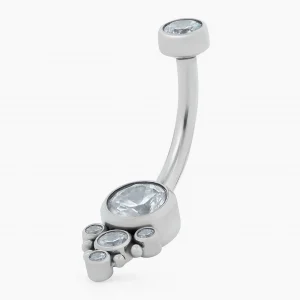
1. Curved barbell – the classic and the starting point
-
The type of jewelry most often used for a navel piercing.
-
A slightly curved bar finished with two balls (the lower one can be decorative).
-
Ideal as a first piece and for long-term wear.
-
Its shape follows the natural line of the navel and does not put pressure on the tissue.
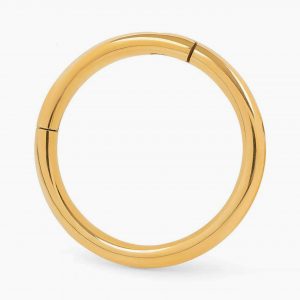
2. Ring (segment ring)
-
A metal ring closed with a ball or a segment.
-
Less common in fresh piercings – it can move more and raises the risk of irritation.
-
Suitable only after full healing, more as a stylish alternative.
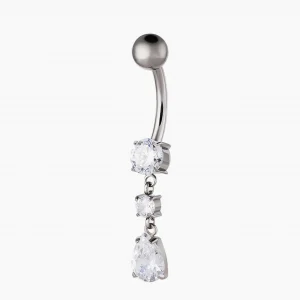
3. Dangling and decorative jewelry
-
A classic curved barbell combined with a hanging element (chains, crystals, charms).
-
Very striking to look at, but suitable only after full healing.
-
Often heavier – best worn only occasionally, not for sleep or sport.
Suitable materials
Titanium:
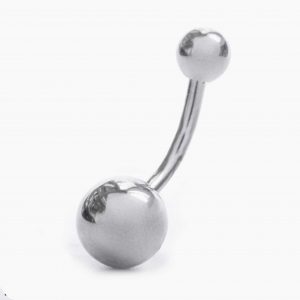
The safest option.
-
Hypoallergenic, light and extremely durable.
-
Contains no nickel, ideal even for very sensitive people.
-
The most common choice in quality studios.
Gold
-
High-purity gold (14k, 585/1000, or 18k, 750/1000) is a luxurious, biocompatible metal that most people tolerate well.
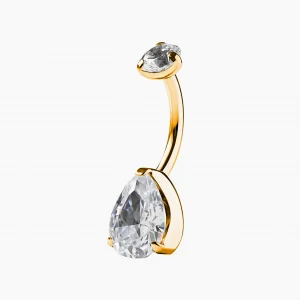
It must be nickel-free, made only from quality alloys intended for body jewelry.
-
It is used only after the piercing has fully healed – gold is a softer metal, so it is not ideal for the initial phase, when mechanical strength matters.
-
Jewelry in yellow or white gold is suitable, polished to a high shine and without unnecessary crevices where dirt could collect.
-
White gold must contain no nickel – nickel is a common allergen. A good maker should be able to document the alloy composition.
The procedure itself: what to expect from a professional piercer
? 1. Consultation and choosing the jewelry
-
At the start the piercer asks about your health, allergies, or medication you take.
-
They check the skin and the anatomy of the navel to confirm that a piercing is possible and will be stable.
-
Then you choose the first piece – the piercer will recommend a safe material (most often titanium) and the right bar length.
-
Everything is explained thoroughly, including aftercare and healing.
? 2. Disinfection and preparing the area
-
The area around the navel is thoroughly cleaned and disinfected.
-
The piercer puts on sterile gloves and prepares all the tools from sterile packaging.
-
The piercing site is usually marked – the piercer shows you in a mirror exactly where the jewelry will sit.
? 3. The piercing itself
-
The procedure is done with a sterile single-use needle (never a gun).
-
The skin is gently stretched, then the piercing is made from top to bottom in one quick, smooth movement.
-
The jewelry is inserted into the fresh channel immediately afterwards.
-
The whole process takes only a few seconds and the pain is brief and well tolerated – most people compare it to a pinch.
? 4. Inserting the jewelry and finishing
-
After the piercing, the piercer secures the jewelry (screws on the ball) and checks that it sits well and does not get in the way.
-
The area is cleaned again and the client receives spoken and written aftercare instructions.
-
It is recommended to stay calm for a while, have a drink and avoid physical strain right after the procedure.
A navel piercing is a simple and very popular procedure, but it should always be done by an experienced and qualified piercer. Avoid unverified studios, home attempts or procedures done with a gun – not only for the result, but above all for your health.
Navel piercing aftercare: how to support healing and avoid problems
The average healing time is 6 to 12 months
The first 2–3 months are the most important – during this period the piercing is most vulnerable to infection and mechanical irritation
✅ Daily care, step by step
1. Cleanliness comes first
-
Wash around the piercing 1–2 times a day with sterile saline solution (0.9% NaCl – available at a pharmacy).
-
Ideally use cotton pads or sterile gauze, and do not soak your whole body.
-
Do not use alcohol, peroxide, Betadine or other harsh disinfectants – they slow healing and dry out the skin.
2. Do not move the jewelry
-
Do not handle the jewelry unnecessarily, do not twist it and do not try to “clean it from the inside”.
-
If dried discharge forms (for example on the balls), soften it gently in the solution and wipe it off carefully.
3. Towel, clothes and bed = clean
-
After a shower, dry the piercing with a clean towel, ideally a paper one.
-
Change your bedding, nightwear and clothes around the abdomen regularly.
-
Avoid tight synthetic clothing – choose loose, breathable materials.
4. Do not touch the piercing with dirty hands
-
Before any handling, always wash your hands with soap and water.
-
Ideally, do not touch the piercing at all unless you have to.
⚠️ What to watch for during healing
It is recommended to skip these for at least 1–2 months:
Pools, hot tubs, natural swimming spots
Sunbathing and tanning beds
Sport and physical activity
Sleeping on your stomach
A piercing is like a small commitment – it rewards you with a beautiful result, but only if you give it enough care and respect. Build the aftercare into your daily routine the same way you brush your teeth, and you will avoid most problems.


